


Captain Hilliard A. Wilbanks Medal of Honor Memorial Scholarship
To mail in a check, send to:
UNG Foundation, Inc.
For: 7891 - Cpt Hilliard A. Wilbanks Medal of Honor Sch
P.O. Box 1599
Dahlonega, GA 30533
Purpose and Overview
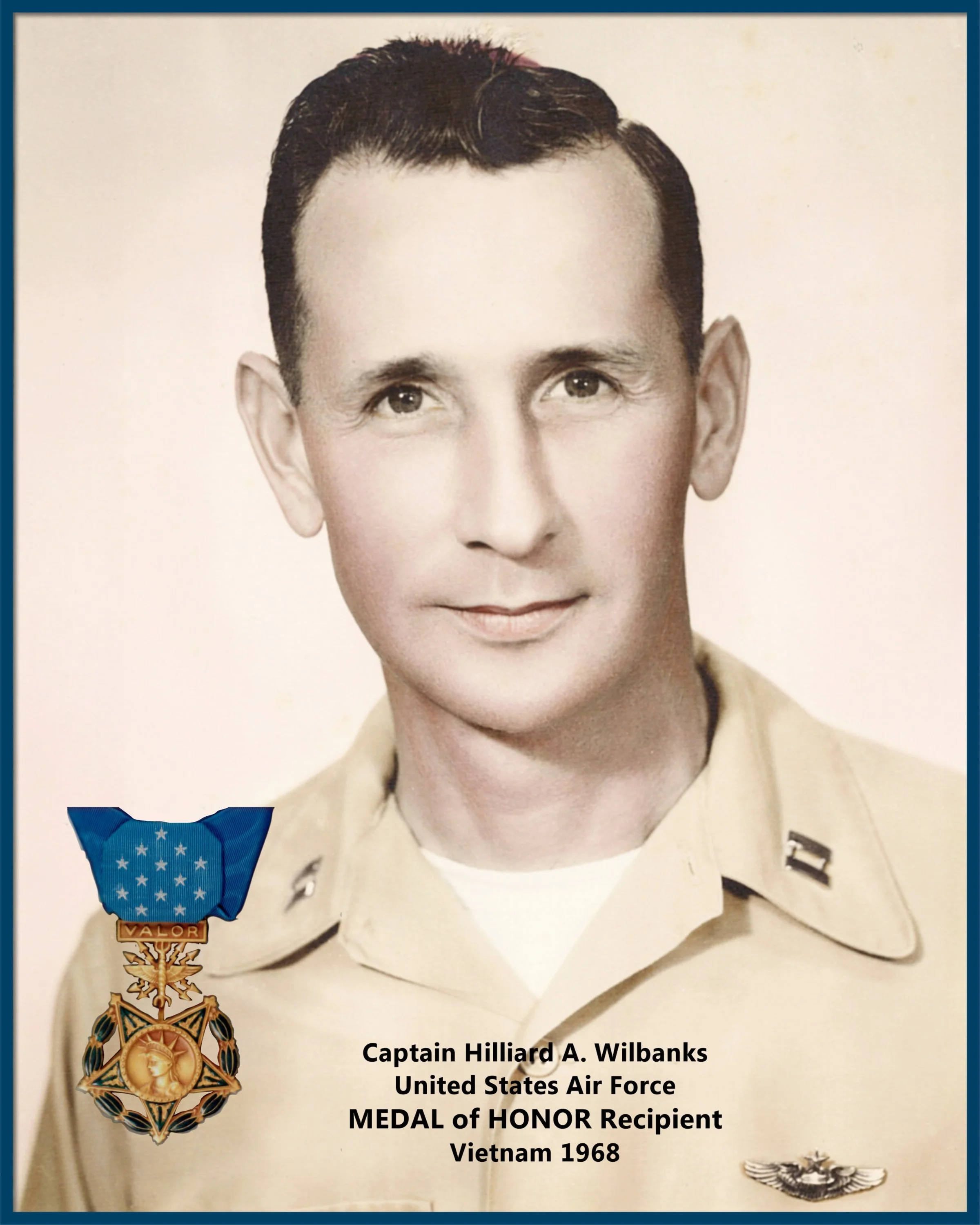
The Captain Hilliard A. Wilbanks Medal of Honor Memorial Scholarship is a prestigious award aimed at providing financial support to Cadets at the University of North Georgia. This scholarship was established by the Hilliard A. Wilbanks Foundation, and honors the legacy of Captain Hilliard A. Wilbanks, a Medal of Honor recipient from Habersham County, Georgia.
The Medal of Honor is the United States of America's highest military honor, awarded for personal acts of valor above and beyond the call of duty. It was created in 1861 during the American Civil War to give recognition to men and women who distinguished themselves "conspicuously by gallantry and intrepidity" in combat with an enemy of the United States. During the past 157 years, there have been 3552 Medals of Honor awarded to men and women of all branches of our nation's military, with 27 of those from Georgia. One of those Georgia natives is Air Force Captain Hilliard A. Wilbanks of Habersham County. It is in his honor that the Hilliard A. Wilbanks Foundation was established.
The Hilliard A. Wilbanks Foundation was established in 2011 to honor the life of Captain Hilliard A. Wilbanks, United States Air Force, Medal of Honor recipient, by awarding scholarships for higher education to deserving high school seniors from Georgia. Scholarship recipients must be seeking a degree that reflects their patriotism and dedication to service in the United States. In fulfilling its mission, the Foundation seeks to promote American values by perpetuating Captain Wilbanks' legacy of courage, sacrifice, and patriotism through increased awareness, education, behavior, and example. By establishing this scholarship at the University of North Georgia, the Foundation, with the approval of the Wilbanks family, seeks to assure that this legacy will continue in everlasting memory of the sacrifice made by Captain Wilbanks.
Captain Hilliard A. Wilbanks’ Story
Enlisted Years
At the tender age of 17 years and 13 days, Hilliard reported to the U.S. Army & Air Force Recruiting Station in Atlanta in August 1950 where he enlisted for four years in the U.S. Air Force. Following Basic Training at Lackland AFB, San Antonio, TX, he was assigned to the 43rd Air Police Squadron, part of the Strategic Air Command at Davis-Monthan AFB in Tucson, AZ. He served as an Air Policeman throughout his four year enlistment and had Temporary Duty Assignments to Guam, French Morocco and England during the Korean War era.
In August 1953, he was awarded the Army Good Conduct Medal (The United States Air Force had just became a separate military service in 1947 and the Air Force Good Conduct Medal was not created until 1963). By 1954, he had been promoted to Airman 1st Class and he wrote letters home saying he was interested in re-enlisting. He was dreaming about flying!
Commission
After passing the Aircrew Test Battery, he was accepted for the Aviation Cadet - Officer Candidate Training Program. Flight training was divided into 3 stages: Pre-Flight (Observer School & Navigation Training at Lackland AFB, TX), Primary (Learning to Fly at Hondo AFB, TX) and Basic (Jets at Laredo AFB, TX). He received his wings and commission as a 2nd Lieutenant and was honored as a Distinguished Graduate on June 15, 1955, with the Class 55-P. After graduation from Aviation Cadets, he was sent to Basic Instructor School at Craig AFB in Selma, AL.
The PA-18 Piper Cub was the first airplane he learned to fly. His solo flight was on July 19, 1954. A letter to his parents from his instructor, Mr. Camp, stated, "He did a very fine job of it and I was justly proud of him. I have been rather closely associated with Hilliard since the first part of July, and I thought you would be pleased to know that I have found him to be an extremely well behaved young man and very cooperative in every respect. He is trying very hard and his diligent application is paying him dividends as is evident by his success thus far in the training program." After the PA-18 came the T-6 Texan Trainer and then ... JETS.
His first duty as an officer was a T-33 instructor pilot at Greenville AFB, MS, with the 3506th Pilot Training Squadron. At 22 years old, 1st Lt. Wilbanks taught young men how to fly. From a letter dated November 6th, "I thought I didn't know too much about flying but after flying with a student here in basic, I feel that I am pretty sharp. I am pretty sure I am going to like this place and instructing just fine."
While stationed at Greenville in 1956, he met and married Rosemary Arnold. In 1959, he was sent to Maintenance Officer School at Chanute AFB, IL, in preparation for the next three-year assignment at America's "Farthest North" Air Force Base at Eielson AFB, AK. He qualified as an F-86 Sabre test pilot and served as an Aircraft Maintenance Officer. He earned his Captain bars while assigned to the 5010th Maintenance and Supply Group in Alaska in 1961 and a month later, their first son was born. In 1962, he received orders for Nellis AFB, NV, where he served as a Flight Line Maintenance Officer on the F-105 fighter-bomber "Thunderchief”. Their first daughter was born while living in Nevada.
The Southeast Asia assignment came with orders to serve as a Forward Air Controller (FAC) in Vietnam flying the Bird Dog, a small Cessna type unarmed aircraft. After FAC training at Hurlburt Field in Florida and an intense survival school in the desert, he departed the United States on March 30, 1966. Two weeks later, their twins were born, a son and daughter that he would never get to see.
Deployment Vietnam
Captain Wilbanks arrived at Pleiku Air Base, Republic of South Vietnam and completed an in-country check-out flying the 0-1 Bird Dog. The Bird Dog could reach 150 mph in an emergency, but the normal cruising speed was 104 mph. The plane had two seats, but Forward Air Controllers usually flew alone. The Bird Dog carried no ordnance except four white phosphorous smoke rockets, used to mark targets. Small-arms fire from the ground could easily penetrate the cockpit. His only weapon was an M-16 that he carried for self-defense in case his plane was shot down and he had to defend himself on the ground.
The FAC's job was to fly low and slow, conducting visual reconnaissance in the same area each day. They became familiar with the terrain and would notice if any significant changes took place. They knew the places where enemy forces might hide. To help other pilots put their ordnance on target, and to lessen the risk of hitting allied forces and civilians, the rules of engagement required that all ground attack strikes in South Vietnam be directed by a Forward Air Controller.
Captain Wilbanks was assigned to the 21st Tactical Air Support Squadron at Nha Trang, but he reported to the Air Liaison Officer for the southern Central Highlands provinces. Attached to the US Army Advisory Team headquartered at Ban Me Thuot and working with the South Vietnamese 23rd Ranger Division, the ALO and his FACs were responsible for the southern half of II Corps, the largest of the four military regions in South Vietnam. They flew numerous missions every day. Hilliard's duty stations included Ban Me Thuot, Bao Loc, and Dalat.
By Feb. 24, 1967, Captain Wilbanks had flown 487 combat missions. He had already earned the Distinguished Flying Cross and 19 Air Medals (one Air Medal equals twenty-five combat missions). He was scheduled to finish his tour and leave Vietnam in March. He had survived eleven months of dangerous duty and he was eager to see his wife and four children. His 488th mission was his last. His courage and heroic action saved many lives that day, and he posthumously received the Medal of Honor for his heroic action. On March 3, 1967, his funeral services were held at Glen Allan Methodist Church in Glen Allan, MS, with interment at Fayette Methodist Cemetery in Fayette, MS.
His Heroic Action
On February 24, 1967, Captain Wilbanks was dispatched in an unarmed observation aircraft to assist in an operation against enemy forces who were attacking near Dalat, South Vietnam. While flying reconnaissance for a South Vietnamese Ranger Battalion, Captain Wilbanks discovered that hostile units were concealed on two hilltops. He immediately called for helicopter gunship support by radio, and alerted the Rangers advancing into the area.
Realizing that their ambush was being compromised, the enemy reacted with a barrage from mortars, machine guns, and automatic weapons. Captain Wilbanks received much of this fire as he marked the enemy positions with white phosphorus rockets for the gunships. Knowing that air support was not going to arrive in time, he personally began firing his M-16 rifle out of the side window of the Bird Dog. Captain Wilbanks distracted the enemy troops and momentarily slowed their advance.
The outnumbered Rangers were afforded a chance to withdraw as the attackers diverted their fire against Captain Wilbanks' plane. Despite his plane being hit repeatedly by enemy fire, Captain Wilbanks persisted in covering the withdrawal. On his third pass, he was severely wounded and crashed in the battle area. The Rangers managed to rescue Captain Wilbanks from the wreckage of his plane, but he died while being evacuated to a hospital.
Captain Wilbanks was posthumously awarded the Congressional Medal of Honor. The presentation was made to his widow by Secretary of the Air Force Harold Brown at the Pentagon, Washington, D.C., on January 24, 1968. He was also awarded the Distinguished Flying Cross, Purple Heart, Air Medal w/ 19 Oak Leaf Clusters, and the Air Force Commendation Medal.
Medal of Honor Citation
Captain Wilbanks received the Medal of Honor for conspicuous gallantry and intrepidity in action at the risk of his life above and beyond the call of duty. As a forward air controller Capt. Wilbanks was pilot of an unarmed, light aircraft flying visual reconnaissance ahead of a South Vietnam Army Ranger Battalion. His intensive search revealed a well-concealed and numerically superior hostile force poised to ambush the advancing rangers. The Viet Cong, realizing that Capt. Wilbanks' discovery had compromised their position and ability to launch a surprise attack, immediately fired on the small aircraft with all available firepower. The enemy then began advancing against the exposed forward elements of the ranger force which were pinned down by devastating fire. Capt. Wilbanks recognized that close support aircraft could not arrive in time to enable the rangers to withstand the advancing enemy, onslaught. With full knowledge of the limitations of his unarmed, unarmored, light reconnaissance aircraft, and the great danger imposed by the enemy's vast firepower, he unhesitatingly assumed a covering, close support role. Flying through a hail of withering fire at treetop level, Capt. Wilbanks passed directly over the advancing enemy and inflicted many casualties by firing his rifle out of the side window of his aircraft. Despite increasingly intense anti-aircraft fire, Capt. Wilbanks continued to completely disregard his own safety and made repeated low passes over the enemy to divert their fire away from the rangers. His daring tactics successfully interrupted the enemy advance, allowing the rangers to withdraw to safety from their perilous position. During his final courageous attack to protect the withdrawing forces, Capt. Wilbanks was mortally wounded and his bullet-riddled aircraft crashed between the opposing forces. Capt. Wilbanks' magnificent action saved numerous friendly personnel from certain injury or death. His unparalleled concern for his fellow man and his extraordinary heroism were in the highest traditions of the military service, and have reflected great credit upon himself and the U.S. Air Force.